VILLANUEVA DE LOS CASTILLEJOS
(JANUARY 25,1811)
INTRODUCTION
The combat of
Villanueva de los
Castillejos
was a very secondary affaire, taking place on 25 January, 1811 during
the Soult's
invasion of Extremadura.
During that expedition, the main column of Soult's army containing
the artillery and following the main route from Sevilla to Mérida,
arrived to Monesterio, the pass between Andalucía and Extremadura,
discovering a column of Spanish infantry only four miles to the
west.
This column was made up of
General Ballesteros’s infantry division,
5,000 strong, which had just been sent south from Extremadura to the
Condado de Niebla, with orders to expel the weak French garrison
from that area, and then to threaten Seville. Its presence disrupted
Soult’s plans and after the Spanish escaped to a first attempt by
Mortier, Soult sent the Gazan’s infantry division to catch
Ballesteros.
Ballesteros conducted a
skilful retreat
across the mountains towards
the lower Guadiana valley, finally standing and fighting at
Villanueva de los Castillejos on 25 January 1811. The combat was a
resounding French victory (French sources) or a skillful Spanish
retreat (Spanish sources) and Ballesteros fled towards Portugal
crossing the Guadiana River at Sanlucar de Guadiana.
Bibliography
- Gómez de Arreche y Moro, José; Guerra de la Independencia. Historia
militar de España de 1808 a 1814, Tomo IX,Depósito de la Guerra,
Madrid, 1895
- Lamare, Jean-Baptiste Hippolyte,
Relation des siéges et défenses d’Olivença, de Badajoz et de
Campo-Maior en 1811 et 1812, Anselin et Pochard Editeurs, Paris
1825
- Mira Toscazo, Antonio, Villegas Martín, Juan y Suardíaz Figueres,
Antonio, La Batalla de los Castillejos y la Guerra de la
Independencia en el Andévalo Occidental, Diputación de Huelva,
Huelva 2010
- Queipo de Llano y Ruiz de Saravia, José María (Conde de Toreno),
Historia del levantamiento, guerra y revolución de EspañaTomo III,
Martín Alegría, Madrid 1847
- Sañudo, J.J. 'Base de Datos sobre las Unidades Militares en la Guerra
de la Independencia', Ministerio de Defensa, Madrid, 2007
-
Victoires, conquêtes, desastres, revers et guerres civiles des français
de 1792 a 1815, C.L.F. Panckoucke Editeur, Volume 20, Paris 1820
TABLE-TOP ADAPTATION
GO TO THE BATTLE IN PICTURES
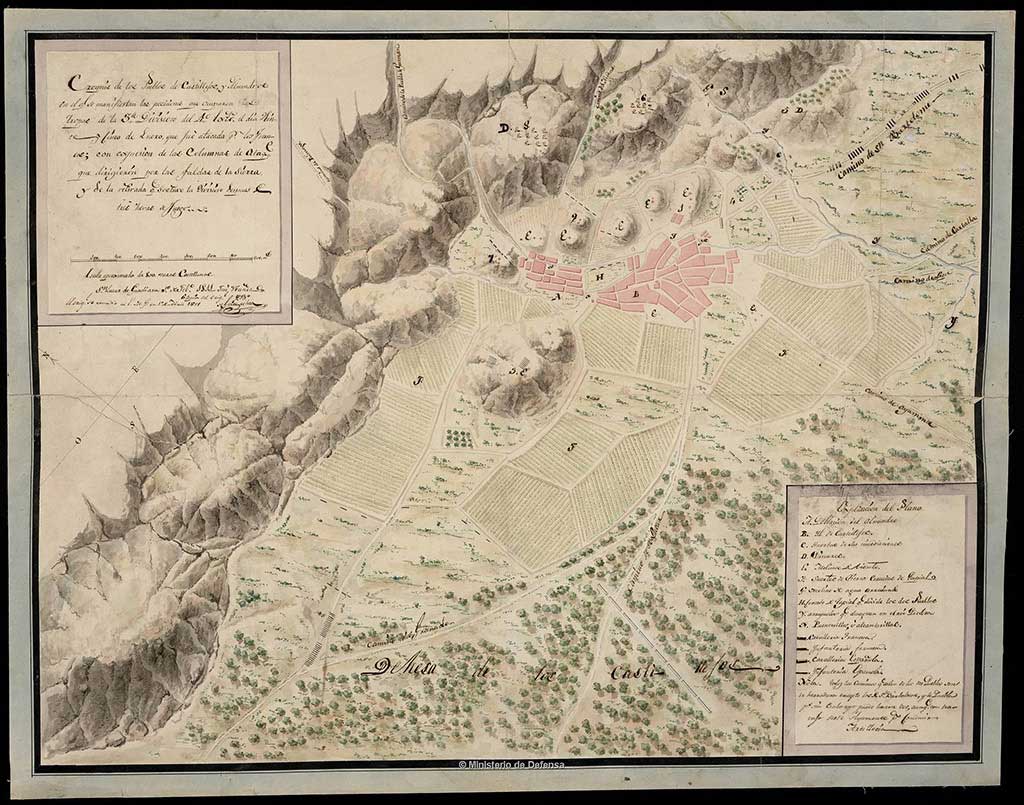
Ibáñez's map
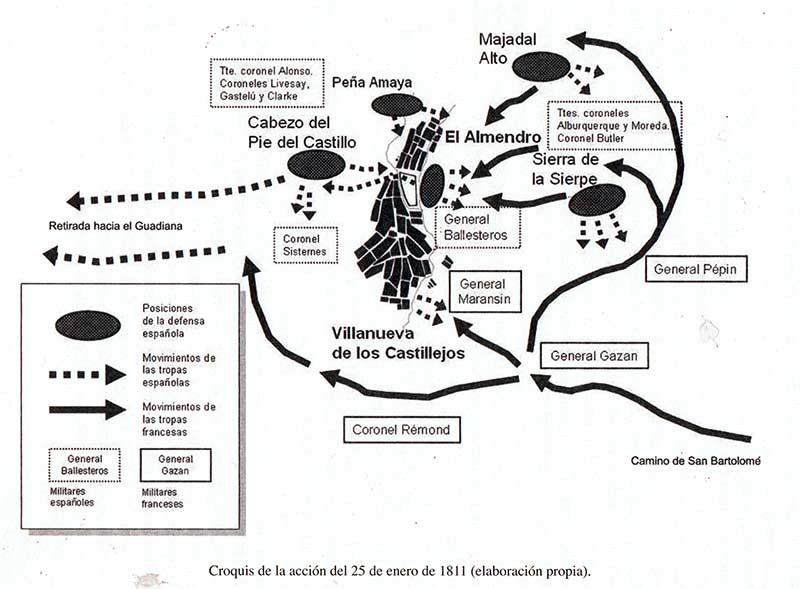
Scheme of the combat
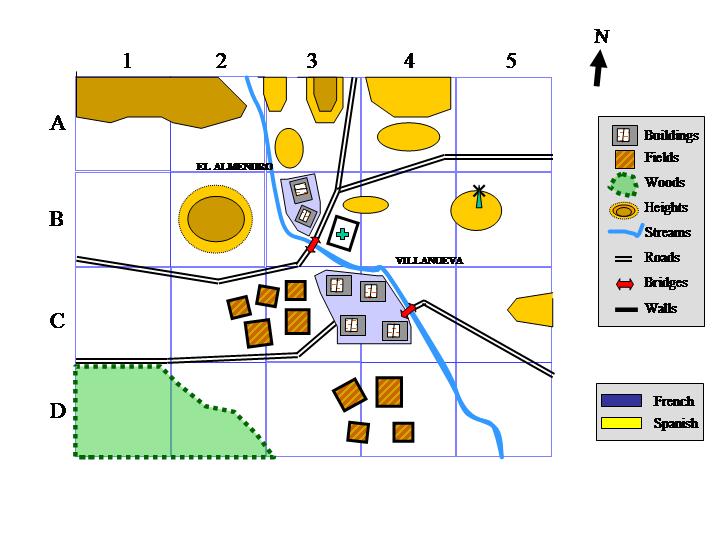
Game map
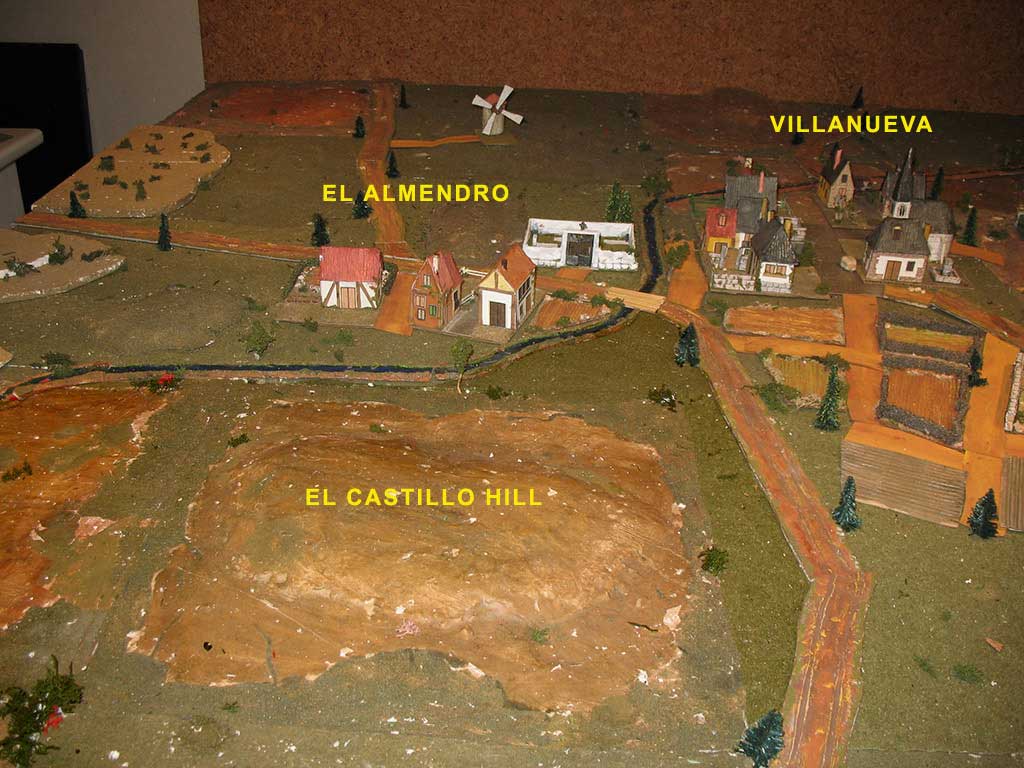
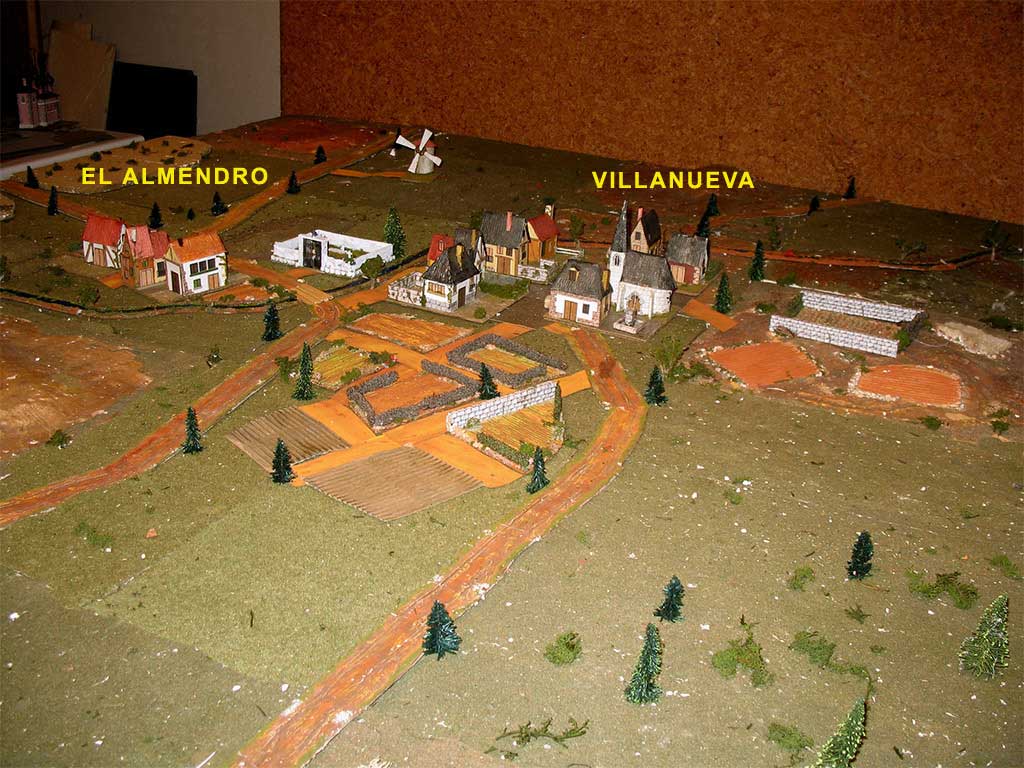
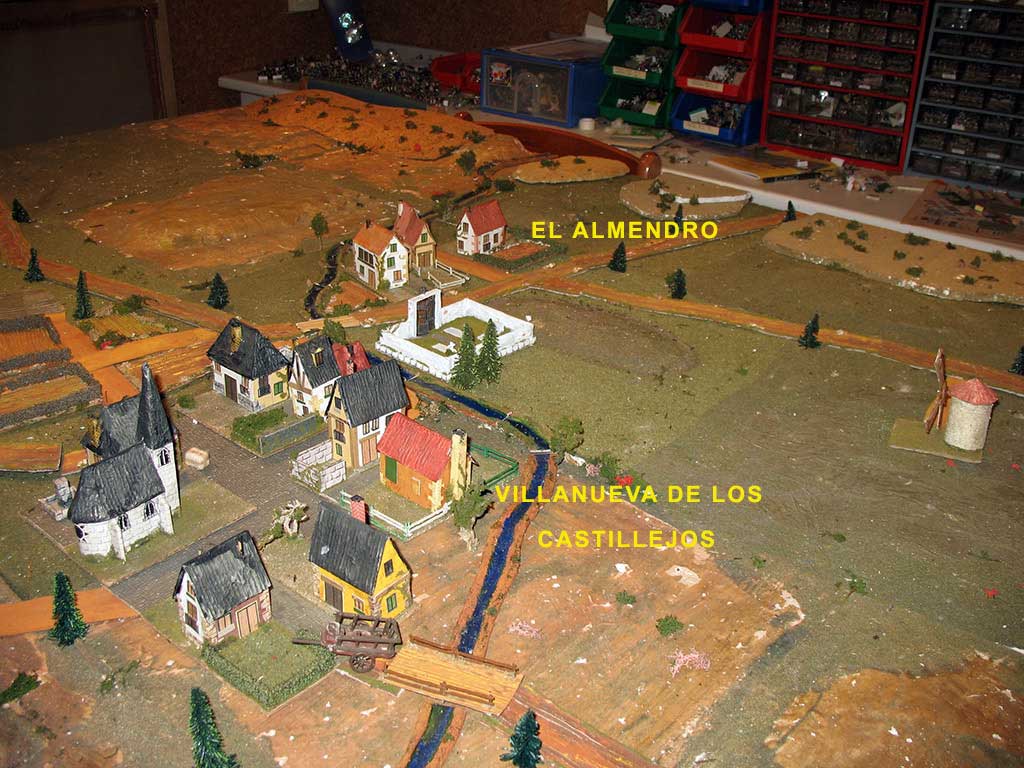
The actual battlefield
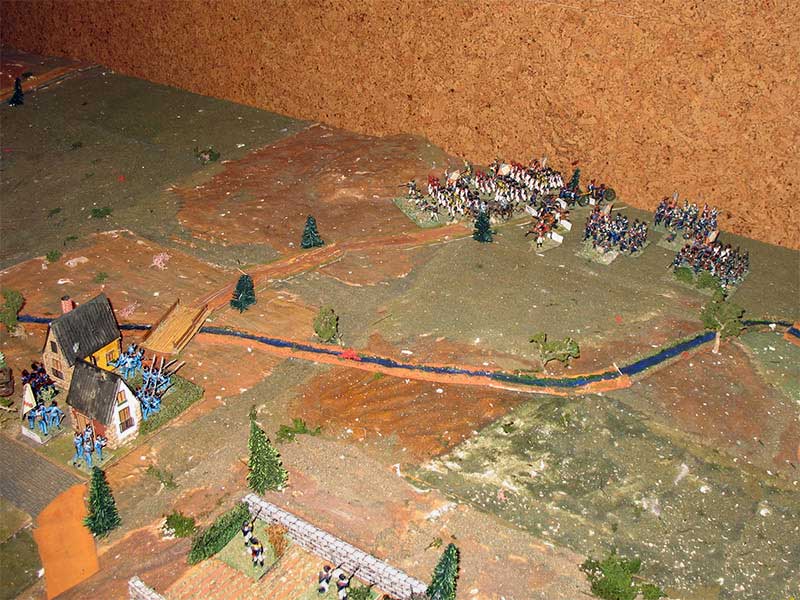
French deployment
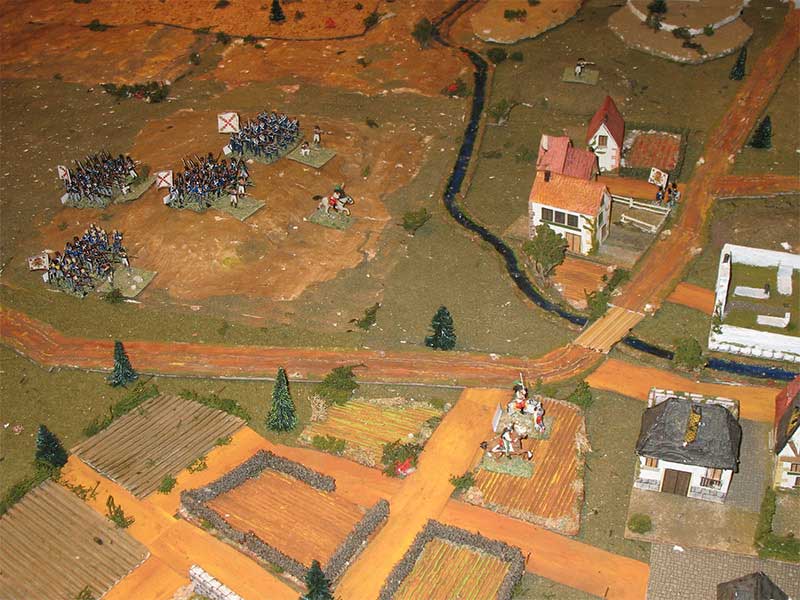
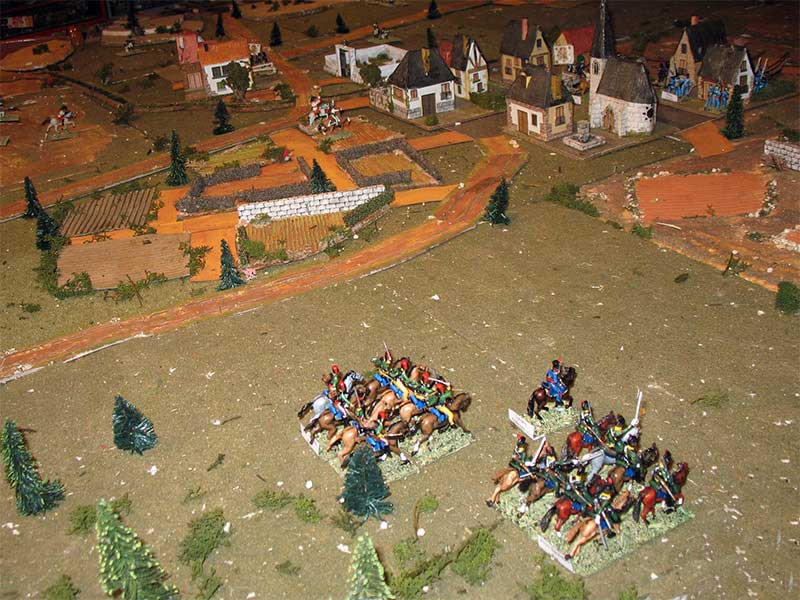
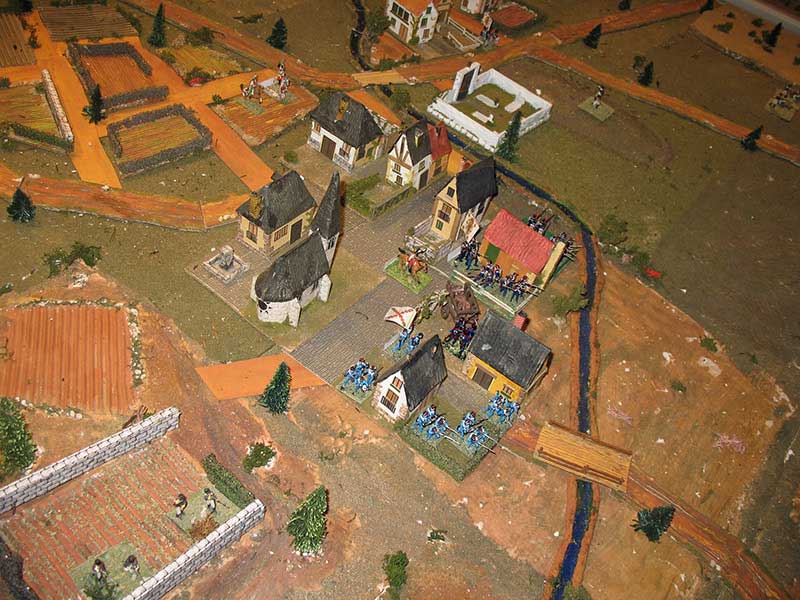
Spanish deployment
Scenario pdf file for Villanueva
GO TO THE BATTLE IN PICTURES
Summary of the oob
French Forces (Army Moral 30; Break point 10)
C-i-C Gazan
Maransin (6 battalions) ; 1 foot battery
Reinforcements
Pepin (6 battalions)
Remond (1 regiment, 1 battalion, 1 gun)
Spanish Forces:
(Army Moral 18; Break point 6 )
C-i-C
Infantry: Moreda (3 battalions) ; Gastelu (4 battalions)
Cavalry: Whittingham (2 regiments)
Notes All Spanish units are on the table. The duration of the
game is 16 Turns (Bonus Turns are allowed rolling 2D10 instead 2D6).
French are the first side. There are not geographical objectives
OPTIONAL RULES
The Tiradores de Barbastro
In the actual battle, Ballesteros placed some companies of tirailleurs
as a first line. This role can be played by the Tiradores de Barbastro.
Roll 1D6 and the result is the number of light companies placed in
advance. On 4 or more, the entire unit is used as irregular.
Entrenched units
All infantry units may begin entrenched, except the Tiradores de
Barbastro, a light infantry unit.
Viva España!
Spanish units add +1 to their Unpredictable rolls if the roll is taken
while the unit is entrenched or in a building
Home Field Advantage and the entry point of the reinforcements
The rule is in use but in a somewhat modified way. Ballesteros knows
that French reinforcements are on way to outflank him but he don’t know
neither the exact entry point nor the exact time of arrival. In the
actual battle, Gazan sent Pepin with his first brigade and Remond with
his column in a circuitous itinerary to fall on the Ballesteros’s left
and right flanks, respectively.
For the arrival turn, use 2D10 instead 2D6 (p. 91 of the
rule-set). The units arrive in march column or attack column as desired.
For the Entry point
- 21 Légêre Régiment (3 bat.) A3
- 100 Ligne Rériment (3 bat.) A5
- Remond column D4/D5 (60% / 40%)
They’ll be back or the Ballesteros goal
If the game ends in a draw, it is considered a Spanish marginal victory.
However, and given the difference in size and quality of the contenders,
is almost impossible for Ballesteros to win this battle in a regular
way. To give him a higher chance, the Ballesteros’s actual goals must be
taken in account.
Ballesteros never thought about defeating Gaza, and his objective was to
delay him until the night, retiring after losing the least possible
number of casualties. Use this rule:
If Ballesteros fails his Army Moral, instead automatically losing the
game, calculate the actual Army Morale ratio, French/Spanish, using the
remaining moral values for each army. Any result lower than 1,67 (the
initial ratio) is considered a Marginal Spanish victory.
Assault of defiles
Lasalle does not allow march columns to fight, so the assaults on
defiles, such as bridges, fortified gates, field fortifications, etc.
can not be played on the table in a convincing way. There was some
friendly discussions in the Lasalle Forum regarding this topics . At
last I have used the Scruf proposal:
1) A march column can assault a defile like a bridge, a fortified gate,
a fort, etc. It represents not only true march columns, but also all
those formations with a very reduced front.
2) It fights at 1/2 dice and with no previous shooting, adding a -2 for
"bad terrain" as they will be fighting in cramped quarters.
3) The enemy can use the "cover" or "higher elevation" modifiers when
applicable.
3) However the small front, the enemy never halves their dice
See a story version at the
Project Leipzig (1813)
blog
THE BATTLE IN PICTURES