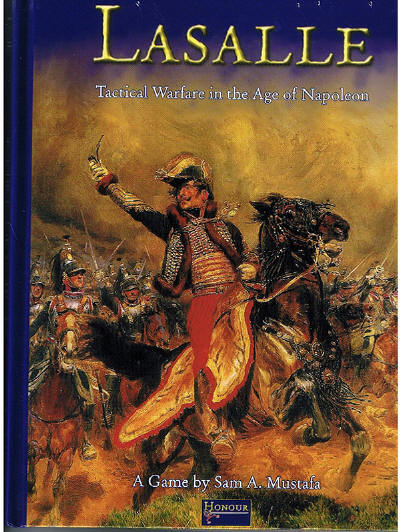
lasalle: first impressions
From a
post in my Project Leipzig blog
(december 4, 2009)
Lasalle,
the first game of the
HONOUR
series, by Sam A. Mustafa
is now available and arrived to my hands the past week,
At at first glance it looks very impressive! . The rules are presented
in a 136 page hard bound book
(in the style of Foundry's
Napoleon) and
the previous experience of the author as rule writer (and as a
teacher I must add!) is visible throughout. The book is very well
written and the rules are clearly explained with the help of many
colour schemes. Some of you would still remember the confused
writing style of old wargaming rules, such the published by the
Wargames Research Group. The
difference, in Sam's favour, is clearly noticeable.
In the author's own words,
Lasalle is addressed to the
"Moment of battle" at
small tactical level: you are a
divisional (or similar) commander and you must carry out your
superior commander's orders without further ado. You
command a small force of 12-18 units (infantry battalions, cavalry
regiments and artillery batteries). The units can be
small (4 bases) or large (6 bases)
, and the number of figures per base is left to the player's
preference. There is not a
fixed figure scale: the small infantry units
represent around 500-700 men whereas large units account for around
800-1000 men. In the case of cavalry small and large units are
respectively 300-500 or 500-700 men, whereas for artillery, a gun
base is two historical guns and their crews.
Sam gives some clues to convert
existent basing systems to Lasalle, but the idea is
to avoid rebasing of previous armies. All measurements are given in
base widths (BW),
so the only requirement is that both sides use the same basing
system.
No terrain scale is stated, but you can use the length
of a battalion in line, as a basic measurement to deduce the
extension and size of your battlefield.
The player is represented by the
Commander figure, and if it was allowed, an additional
Sub-commander is also
included with two cahracteristics, named Vigor and Tactics. The
Command Range is
used (10 BW for
the Commander and 6 BW for the Sub-commander). However, units
'out of command' suffers
only small penalizations in combat, changes or formations,
Discipline tests (see below). The main effect is the impossibility
of recovery and charge/countercharge movements. The Commander (i.e.
the player) has not any characteristics: the Sam's approach is that
you, with your inherent qualities or
defects, are commanding the force.
The troops are defined by Esprit
in Valiant, Reliable and Shaky, and by
Discipline in Experienced,
Amateur and Irregular (grenzers, baskhirs, etc...).
There some special characteristics:
Shock, Pursuit and
Lancers for cavalry and
Guard for all
branches of service. The guns are
Foot or Horse and also
Heavy, Medium or Light (with a possible
howitzer designation). The
Discipline is important because there are some
instances under which an unit must take a Discipline Test.
The allowed formations
for infantry are the habitual:
Line, Attack Column, Square and March Column. For
cavalry are Abreast
(line), Waves
(column with a two-bases depth) and
March column. For artillery:
Limbered or
Unlimbered.
Skirmishers are shown as markers, small two-figure
bases, used to shown the Skirmish level (0-3) of the unit, that may
improve your success in a fire-fight.
Terrain can be
Open or Rough as
well as Dry or Mud.
The Cover can
be
Hard or Soft.
Hills must be
defined by the players. There is the habitual Table, covering all
variations.
The Moral aspect
of the units is covered with the
Disruption concept: when the units suffers from
fatigue of battle, it acquires disruption and becomes less-able to
perform and more likely to break. When an unit suffers a
number of Disruptions (DISR) equals to its number of bases, it
breaks and is removed from play. The units can
remove disruption by Recovering.
No time scale is
stated. Lasalle
is played in alternating turns
for each player (igo, ugo) and each turn is sub-divided in four
Phases, in a way somewhat different to the current habitual systems.
1) Reaction Phase
(you react and shoot). Defending units take reactions. Options include
a change of formation, countercharging, fall back or fire.
2) Combat Phase
(you defend in combat). Resolve combats including retreats and
advances.
3) Activity Phase
(you move and recover units). Move units (including charging) and make
recovery attempts.
4) Status Phase
(Moral etc). Remove markers, enter reinforcements and check army
morale
An unusual characteristics of the Lasalle book is that chapters do not
proceed in the above sequence. The author has used a
more pedagogical approach:
1) Activity Phase (third
sub-phase)
Movement. During
the activity phase the "moving side" player selects a single force
and moves each unit of that force. Movement allowances (measured in
BWs) depend on unit type and formation. An infantry unit in Attack
Column line, for example, has a full movement rate of 2 BWs. Changes
of formations and maneuvers are addressed in a standard way, and
some Troops may need to pass a previous Discipline Test. The
Charge movement, i.e. the
move to contact with the enemy, is also regulated.
Recovery is based on Discipline
tests. A die is rolled but if you unit moved, you
must add another die roll, and another more if it is near the enemy.
All die throwns must pass the test.
2) Reaction Phase (first
sub-phase)
You have a chance
to react to the moves made by your opponent at the end
of his previous turn. The possibilities are: About face, Change
Formation, Countercharge, Fall back and Fire. Fire does not require
a Discipline test, whereas the other reactions may need one in some
occasions.
Fire combat
occurs during your own Reaction Phase, i.e. before you move or charge
into combat. Lasalle uses a simple
Kill Dice system. You
roll a number of dice (one for infantry base or roundshot firing
gun, or two for canister firing gun) attempting to score a 4+ on
each die. Each success inflicts one hit. At the end of fire, hits
are
translated into Disruption markers, using the adequate
table. There are modifiers
in fire combat for cover or having a better Skirmish value, or for
certain other situations (firing roundshot at a square for example).
At long range artillery may score Bouncethrough hits.
3) Combat Phase (second
sub-phase)
After the Reaction phase, you must to
resolve combats. During
your turn, your are always the "Defender".
Combat. Units
must be in base contact and each side rolls a number of dice
attempting to score hits. If one side scores twice as many hits as
the other a Decisive result
has been reached. Otherwise the result is
Inconclusive. The number of dice of each side
may be modified depending on the situation, type of unit, formation
and terrain. For example, Guard units add 2 dice whereas the units
must subtract one die for each Disruption marker. Units may to halve
their dice in a when flanked, etc.
The sequence of combat resolution
is important because a unit might be in contact with two enemy units
and be forced to fall back by one before it can help fight the
other. The side choosing first is decided by the throw of a die and
after, the choice alternates between players.
If the result is Decisive,
the defender breaks and the attacker advances. Otherwise the loser
falls back. If the attacker has won he must advance (defenders never
advance even if they win). The
combat loser takes 1 DISR (and may break, being
removed for play). Winning
cavalry also takes 1 DISR for each won combat except
when if doing so would break it.
4) Status Phase (fourth
sub-phase)
You can enter reinforcements, determine army morale
and check if the game has ended and the type of victory
The Game Basic Length
for Competition games is 16 turns (8 for each player), and it will be
fixed for historical scenarios.
Bonus Turns may be added by throwing dice (a
reminiscence of Grande Armee, the first Sam's ruleset).
The Army Morale level
is calculated by adding up all the units of the army: Large Infantry
and Cavalry count 3 points each, Small Infantry and Cavalry 2 points
each, and Artillery 1 point per unit. The
Army's Breakpoint is
reached when the moral point value of its broken units (calculated
as above) is greater than one-third of the Army Morale level. In
that case, you must pass a Morale Check with five dice, whose total
roll must be greater than the current turn number.
The rules about towns
(or built-up-areas in NB jargon) are presented in a single chapter. A
town base represents an area large enough for one unit (a small
hamlet or a chateau) so large towns and cities can be shown be
arranging several bases in a grid-fashion. The town bases can be
individually fought by the two sides.
There are some Advanced Rules
giving tactical skills to Sub-Commanders, addressing officer
casualties, AdC's, Irregular units, Entrenchments, Rifles,
Engineering, Howitzers, etc....
The rule book includes three
Scenarios
- The Battle of Venzone, 11 april 1809
- The Struggle for the Pratzen Heights, 2 December 1805
- The Final Push at La Haie Sainte, 18 June 1815
As well as a section about the
'Set up of a game' including weather, a set of
pre-designed boards (or tables) customizable by adding terrain items
and objectives, and the arrival of reinforcements.
The next Section is the Army
Builder. This system allows to create
balanced forces
for each of the six major powers (Austria,
Great Britain, France, Prussia, Russia and Spain) in
different theaters and periods. For example France is given list for
Conquest (1805-1807), Empire (1808-1812), Peninsular (1808-1813),
Liberation (1813-1814) and The Hundred Days (1815). There are also
lists for Minor and Other
States: Bavaria, Brunswick, Confederation of the
Rhine, Denmark, Holland and Dutch-Belgian. Kingdom of Italy, Naples,
Portugal, Saxony, The Duchy of Warsaw, Westphalia, Württemberg, The
Ottoman Empire and Sweden.
The book is finished with a
F.A.Q. section and the Tables or
Quick Reference Sheets.
Ya can also look at two reviews
of Lasalle. The first one is from Mark Severin's
Deep Fried Happy Mice
site and the other was posted by David Brown in
The
Miniatures Page
site.
According to the last news,
Lasalle will be translated into Spanish (La
Armada) . The planned publication date will be the first months
of 2010.
Following the best tradition of Sam's rulesets, the
HONOUR
web site is full of items, including a Forum and a Wiki section
devoted to the design of Scenarios, so it is worth to visit it.
Summarizing, Lasalle
looks like a very good ruleset for
small tactical confrontations at
divisional level. You have your orders from your
Commander-in-Chief and you must to obey. No grand-tactical
subtleties are allowed: the force on the hill-line at your front
must be defeated or your must defend the town at your left, until
the last consequences. The
defeat of the enemy is the only thing to be considered,
so combat becomes the focal point of the action. Evidently, some
things must be simplified and abstracted to allow greater
playability, but this occurs, in a way or another, in all the
wargaming rulesets.
I think I'll give it a try!
|
|