SECTIONS
lindenau
related pages
miscellaneous

Austrian Jägers skirmishing
lindenau (october 16, 1813)
| GO TO THE BATTLE IN PICTURES |
INTRODUCTION
The battle of
Lindenau (October, 16) was the western section of the
battle of Leipzig, the climatic
culmination of the autumn campaign in Saxony. In 1813, Leipzig was
the hub of ten major roads. Three of the roads approached the city
from the west, merging into a single road at
Lindenau
that passed across the Elster and Pleisse Rivers on a series of bridges
(5 principal and six minor ones) and causeways, forming a
natural bottleneck. Lindenau was the
only real withdrawal route for
Napoleon, but for some reason (maybe political Austrian
considerations) the Allied did not choose to block the Napoleon's
exit to France.
The only major Allied unit in the zone was the
Gyulai's weak III (Austrian) Corps, a force very
inadequate to the task. The defence of the area was commended to
Margaron's Leipzig garrison, with the help from the
Quinette's brigade from the 4th
Heavy Cavalry Division and from the very diminished
Bertrand's IV Corps.
The OOB’s, maps and and narrative have been taken form the Nafziger’s
and Smith’s books and the 3rd Military Mapping Survey of
Austria-Hungary.(See Bibliography). The Scenario is designed for
‘one half’ Napoleon’s Battles, with a ground scale of 1”:50 yards
and 1 figure:60 men.
This Scenario is figuht with the 3rd Edition of
Napoleon's Battles.
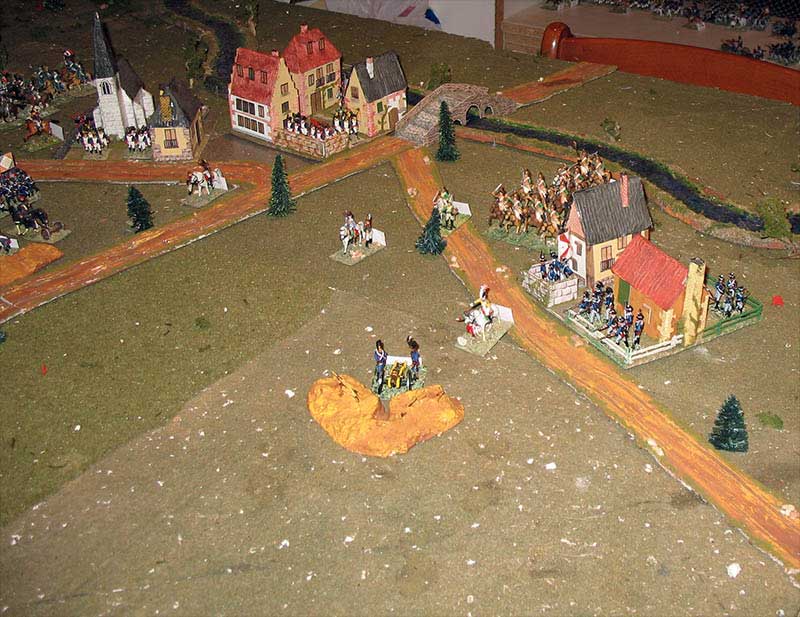
TABLE-TOP ADAPTATION
| NB Scenario for Lindenau | |||
 |
 |
||
| Nafziger map | Table map | ||
 |
 |
 |
 |
| The battlefield | |||
 |
 |
 |
 |
| The French deployment at Lindenau | |||
DEPLOYMENT
French
Arrighi, the Leipzig garrison (Le) and the Quinette's
cavalry (2B/4HC) are on the table at the start of the game.
The IV Corps units will arrive from Leipzig, in march column
formation, by the D3 end-road in the following order:
12/IV 11.00 h ; 15/IV 11.30 h ; 29/LC/IV 12.00 h ;
38/IV 12.30 h ; Artillery Reserve (IV) 13.00 h.
The exact order of arrival within each division must be diced out. No
unit can enter until the precedent one vacated the arrival point.
The Generals always arrive with their first unit. Apply the OR
13.8.2
rule for Varying Time Arrivals
Austrian
No Austrian units are on the table at the start of the game. Thre
different variations of the Scenario are provided:
The non-historical easier way
Gyulai must to divide his command in three columns: left, right and
center, comprised respectively from the 1st Brigade of the
Liechtenstein's Light Division (1B/LD), the complete
Crenneville's 1st division (1/III) and the bulk of the III
corps (III) with the rest of the Liechtenstein Division and the
Mensdorf's and Thielmann Streifcorps. The respective arrival turn
and entry points are: B5 road 9.00 h; B1 road 9.00 h and A4 road
10.00 h
The semi-historical way
Similar to above, but the the entire (1B/2/III) brigade,
including its divisional commander, is considered to be detached so
it is not available.
The historical way
Similar to above, but the composition of the columns is the real
devised by Gyulai (See the
Scenario file for details)
In all the cases, infantry and artillery units can arrive in column or
march column as desired. Batteries arrive limbered. The Generals
always arrive with their first unit. Apply the OR 13.8.2 rule
for Varying Time Arrivals.
CALLING THE DETACHMENTS
For the reasons given above, the strength of the Austrian force
committed to the assault of Lindenau was very insufficient for the
task. In order to see if those additional forces could have inclined
the balance towards the Austrian side, use the following procedure
with the last optional Austrian deployments:
"Starting in the 14.00 turn, Gyulai, if in command, will
throw 1D10. The first time a "1" is required, the second time
a "2" or less, the third time "3" or less etc. until successful
(since Gyulai must be in command, it is necessary to annotate the
turns in which the die is thrown). In this moment, Gyulai can send
for the detachments, that will start to roll for arrival one hour (4
turns) later (Apply the OR 13.8.2)".
RISK TO ATTACHED GENERALS (from Alfonso Peral
a.k.a Lannes)
At the end of a combat, any General attached to a
participating unit, must to check to see if he becomes a casualty by
rolling 1d10. On a roll greater than his 'combat modifier'
the general is moved to safety. On a roll equal or less, the
General Elimination Table must be consulted. If the attached unit
was
routed, a '+3' is added to the 'combat modifier' and if the General
is defensive, with a letter D, subtracts '1' from the
general's 'combat modifier'.
Similarly, any General attached to a unit suffering one loss or more in
the fire phase, must make a similar checking by rolling
1d10. If the unit did suffer 1 or 2 losses, the General passes
the test by rolling '2' or more. If the unit suffers 3 or more
losses by fire (and it is not routed), the General is safe by
rolling '3' or more. If the unit is routed by fire, the general is
safe with '4' or more. If the General do not pass the test, consult
the General Elimination Table.
VICTORY POINTS
The key points and the percentage of victory points allotted are the
bridge (40%), the two buildings of Lindenau (10% each), the building of
Plagwitz (10%), the end-roads B1 and B5 (10% each) and the two
buildings of Schönau (5% each). This is a defensive scenario
lasting more than 12*2=24 turns. The French have 447/0,95=471
adjusted points and the Allied, 603. The multiplier for the weaker
side (French) is 60/471*1,2= 1,54 in NB1 and NB2-3 (262 and 105
victory points respectively).
HISTORICAL OUTCOME
The actual battle of Lindenau was a stalemate, but although the
Allied do not achieve their objective, the French Bertrand's IV
Corps was immobilized during all the day. Since these troops were
desperately needed in the southern front (Wachau), where just one
more Corps would probably have given the victory to Napoleon, the
Allied achieved a good result. However, the withdrawal rout to
France remained open, to be used by Napoleon
BIBLIOGRAPHY
-
3rd Military Mapping Survey of Austria-Hungary
- Hofschröer P., Leipzig 1813. The Battle of Nations Osprey Publishing,
London, 1993
- Nafziger G. ‘'Napoleon at Leipzig. The Battle of Nations 1813”, The
Emperor Press, Chicago, 1996
- Riley J.P., Napoleon and the World War of 1813, Frank Cass, London,
Portland, 2000
- Smith D, 1813 Leipzig. Napoleon and the Battle of the Nations
Greenhill Books, London, 2001
| GO TO THE BATTLE IN PICTURES |